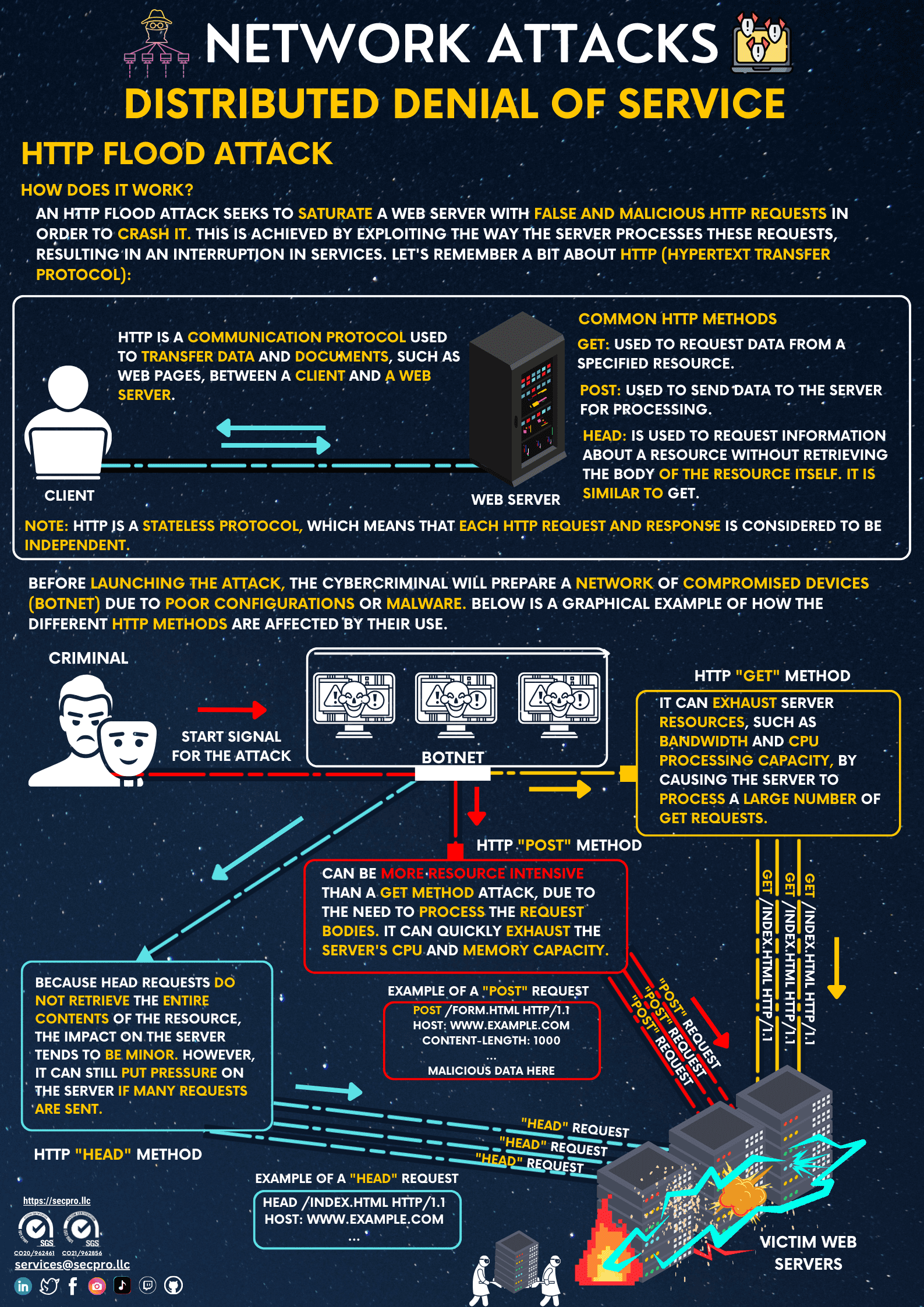
What is an HTTP Flood attack?
The HTTP Flood is a layer-7 (application) DDoS attack that overwhelms a web server with a flood of seemingly legitimate HTTP requests (GET or POST). Unlike volumetric attacks, it doesn't try to saturate bandwidth but to exhaust server resources — CPU, memory, database connections — with requests that look like a normal user's, which makes it hard to detect.
GET Flood vs POST Flood
The GET Flood repeatedly requests heavy resources (images, dynamic pages) to force the server to process them. The POST Flood submits forms or payloads that force backend processing and database queries, consuming more resources per request. Both are usually run from botnets to simulate realistic, distributed traffic.
How to mitigate an HTTP Flood?
Effective defenses include a WAF (Web Application Firewall), per-IP and per-session rate limiting, CAPTCHA or JavaScript challenges to filter bots, edge caching (CDN), and behavioral analysis to tell real users from automated requests. We cover this attack in depth on our blog.