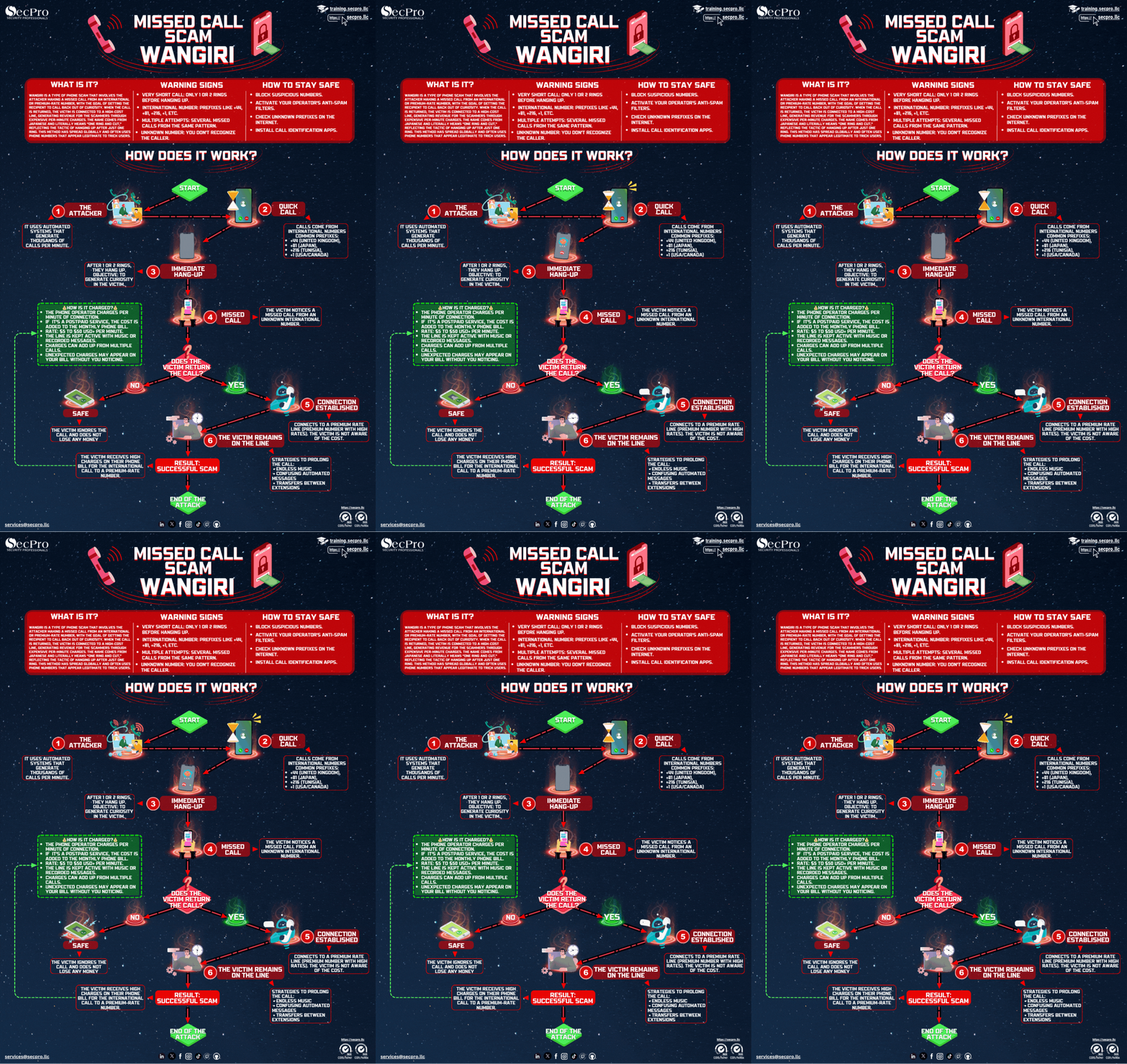
What is Wangiri fraud?
Wangiri (Japanese for 'one ring and cut') is a phone fraud where scammers place missed calls from premium-rate international numbers. The victim sees a missed call, calls back out of curiosity, and gets connected to a premium number charging very high per-minute rates, which the scammers split.
How does the scam work?
Attackers mass-dial thousands of numbers letting them ring only once. They bet a percentage will call back. The numbers usually have obscure international prefixes that look legitimate. Some variants use SMS with the same goal.
How to protect yourself?
Don't return calls to unknown international numbers, check the country prefix before dialing, block suspicious numbers and report them to your carrier. Companies can set outbound international call restrictions to avoid fraudulent charges.
Where the money actually goes
The fraud rests on revenue sharing in international call termination. The attacker rents a premium-rate range in a country with high termination fees and splits the proceeds with whoever operates that range. Every minute you stay on the line — hold music, a fake recording or plain silence designed to keep you waiting — is billed at that elevated rate and shared back. That is why the call cuts after a single ring: a missed call costs the attacker almost nothing, and the return only begins when you dial back.
Why the number looks familiar
Numbers are chosen so the prefix resembles a domestic area code, or they are spoofed to mimic the format of the victim's own number — so-called neighbour spoofing. On a phone screen, an unfamiliar prefix next to a missed call at three in the morning reads as something urgent rather than something foreign. The giveaway is the combination: an unknown international number, exactly one ring, and often several colleagues receiving it the same night.
What to do if you already called back
Hang up immediately — the charge accrues per minute, so the damage is bounded by how long the line stays open. Then check your bill or prepaid balance for the specific charge, report it to your carrier citing the number and the time, and ask whether they can block that range. Some operators refund if the number is already on a known fraud list. Finally, block the number on the device so an automated redial cannot repeat it.